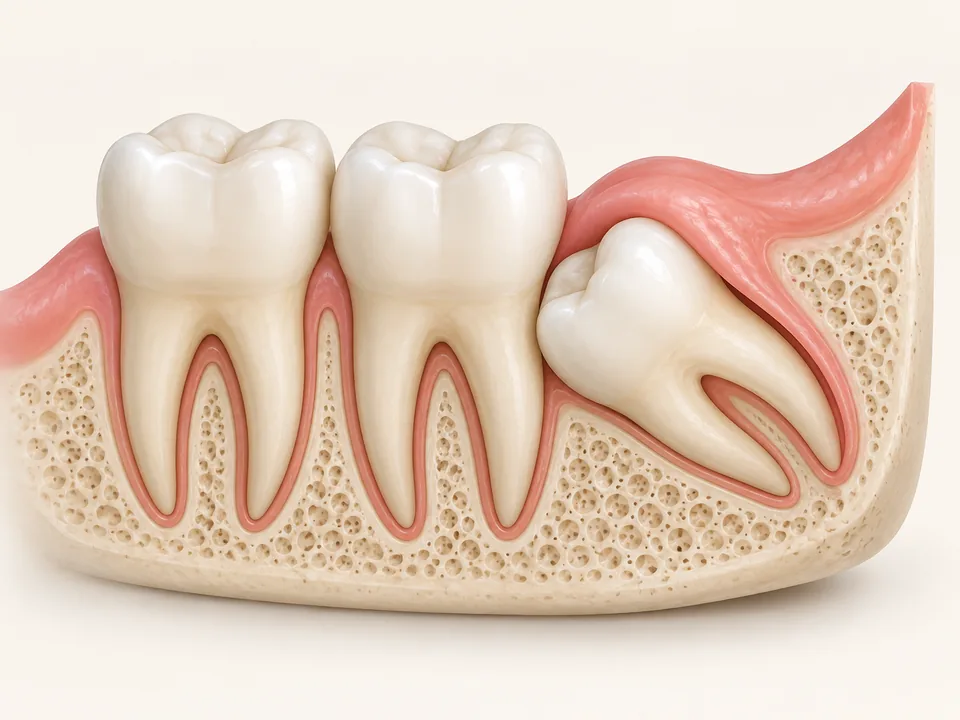
A wisdom tooth that erupts straight and cleans easily can stay. The problem is the ones that come in at an angle, half-covered by gum, jammed against the second molar. Food and bacteria collect in the pocket, the gum flap gets infected repeatedly, and decay starts on the back surface of the healthy molar in front, a surface no toothbrush reaches.
That is the case worth acting on early. By the time the second molar has decayed under the contact point, you are often looking at a root canal or an extraction of a tooth you actually need.
Extraction is done under local anaesthesia. For selected impacted lower teeth, CBCT may help assess the relationship between the roots and the inferior alveolar nerve when conventional imaging is insufficient. Your clinician explains the imaging needed and the risks of the procedure.
You probably need this if…
- Pain or throbbing at the very back of the jaw
- Swollen, red gum flap over a partly erupted tooth
- Difficulty opening your mouth fully
- Bad taste or smell coming from the back of the mouth
- Pain radiating to the ear or along the jaw
- Food constantly packing behind the last molar
Recognising two or more of these does not confirm a diagnosis. It means an examination is worth booking before the problem gets more expensive.
How the treatment works
- 01 Assessment and imaging
Clinical assessment and appropriate dental X-rays; CBCT is considered when additional 3D information is needed for planning.
- 02 Local anaesthesia
The area is fully numbed. Sedation is available for anxious patients or multiple extractions.
- 03 Extraction
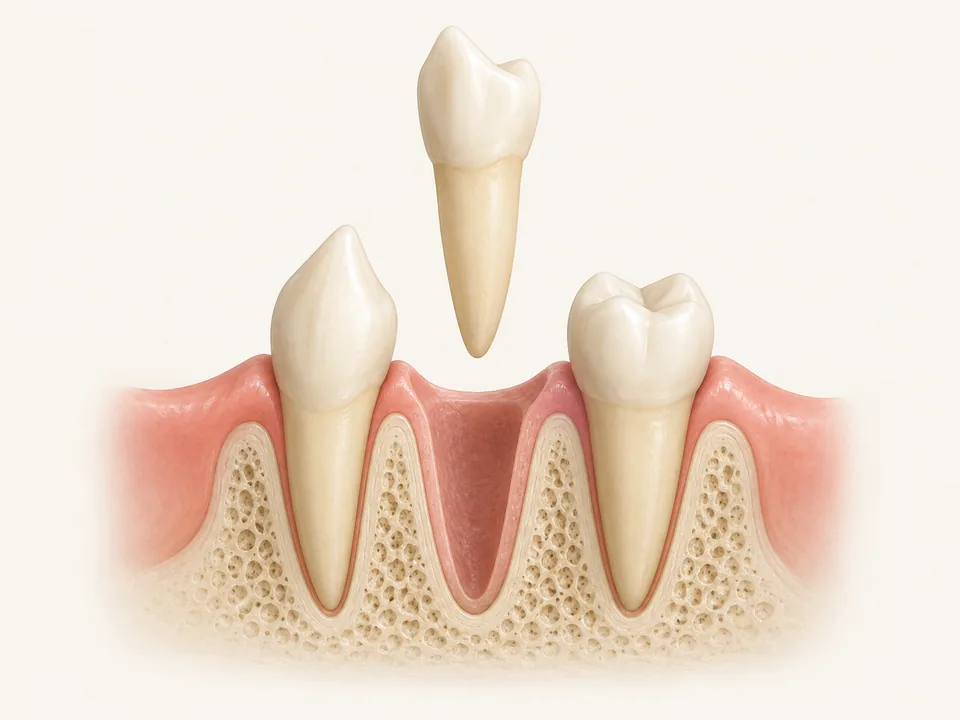
A simple erupted tooth takes 10–15 minutes. An impacted tooth requires raising a flap and sectioning the tooth, taking 30–45 minutes.
- 04 Suturing
The site is sutured. Sutures are removed after 7 days, or dissolve on their own.
- 05 Recovery
Swelling peaks at 48 hours and settles by day 4–5. Written aftercare instructions and a follow-up call the next day are standard.
What wisdom tooth removal costs in Lucknow
Wisdom tooth removal cost in Lucknow depends on how the tooth has erupted, its position and whether a surgical approach is needed. Examination and any appropriate imaging help the dentist assess the procedure and explain the estimate.
Your written estimate sets out the recommended treatment and any separate charges. The guide below explains what to check before agreeing to the plan.