Why your tooth hurts more at night (and what that pain is telling you)
If you are reading this at 2 AM, the short answer is: sleep propped up on two pillows, take ibuprofen if you can tolerate it, rinse with warm salt water, and call a dentist when it is light. Do not put heat on your face and do not hold an aspirin against the gum.
The longer answer is worth reading tomorrow, because the pattern of your pain tells you more about what is wrong than almost anything else.
Why night makes it worse
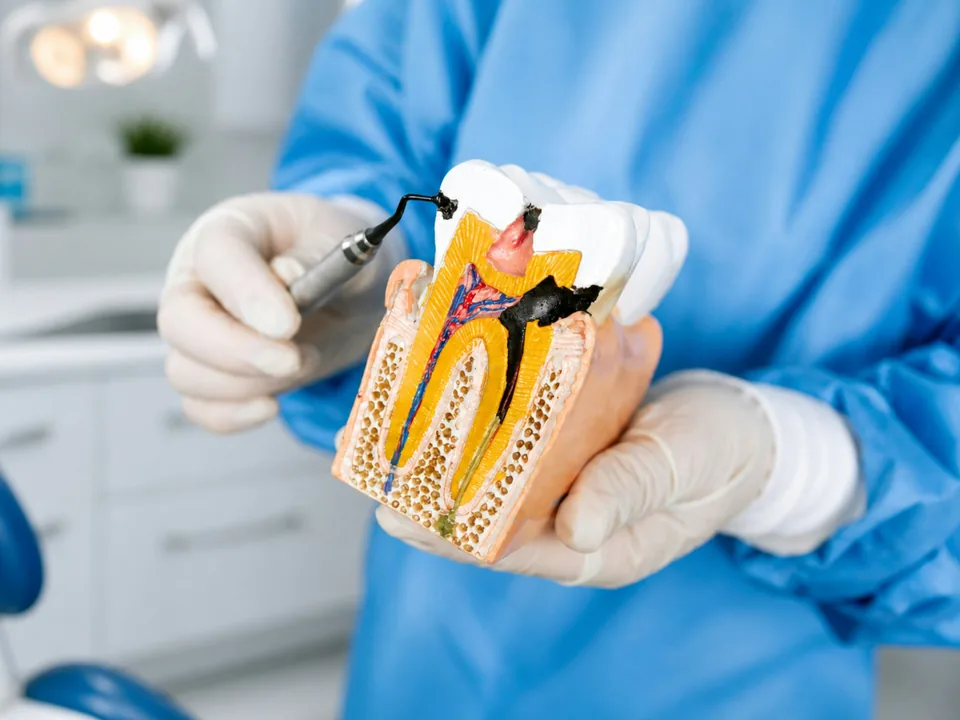
When you lie down, blood pressure in your head rises. In a healthy tooth you would never notice. In a tooth where the pulp (the nerve and blood supply inside) is already inflamed, that extra pressure has nowhere to go. The pulp chamber is a rigid box surrounded by dentine. Inflammation swells; the box does not.
That is the mechanical part. The other part is attention. During the day the ache competes with work, traffic and conversation. At midnight it has the room to itself.
What the pattern of the pain tells you
Dentists sort toothache mostly by how it behaves, and you can do a reasonable version of this yourself before you come in.
Sharp, brief, triggered by cold, gone within seconds. Usually dentine sensitivity or a shallow cavity. The nerve is irritated but healthy. This is the cheap end: a filling, or sometimes just a desensitising treatment.
Sensitivity that lingers for a minute or more after the cold has gone. The pulp is inflamed beyond the point of recovery. This is the tipping point where a filling stops being enough and a root canal starts being the answer.
Throbbing that wakes you, worse lying down, poorly localised. Irreversible pulpitis. The nerve is dying. This needs a root canal, and waiting only makes it more complicated.
Sharp pain on biting down, well localised to one tooth. Either a cracked tooth or an infection that has moved past the root tip into the ligament. The fact that you can point to the exact tooth is diagnostic. Pulp pain is vague, ligament pain is precise.
Constant pain with a swollen face or gum. An abscess. This is the one that needs a same-day appointment rather than a Monday appointment, particularly if the swelling is spreading or you cannot open your mouth fully.
The dangerous version: pain that stops
This is the pattern that costs people teeth.
The pain builds over days, becomes severe, and then over 24 to 48 hours fades away completely. It feels like recovery. It is almost always the nerve dying.
A dead nerve stops sending signals. The bacteria do not stop. They continue down the root canal into the bone at the root tip, where they form an abscess with no live nerve to report it. People come in four months later with a swelling and say “but the pain went away in April”. By then the treatment is longer, the tooth may need re-treatment or extraction, and there is bone loss around the root that was avoidable.
If severe toothache resolves by itself without treatment, book the appointment anyway.
What actually helps overnight
- Elevate your head. Two pillows. This directly reduces the pressure that is making it throb.
- Ibuprofen over paracetamol, if you have no contraindication, because the problem is inflammatory. Follow the packet dosing.
- Cold, not heat. A cold compress on the cheek constricts blood vessels. Heat dilates them and increases pressure inside the tooth.
- Warm salt water rinse. Genuinely helpful for gum-related pain and for clearing debris.
- Avoid chewing on that side, and avoid very hot, very cold and very sweet food.
What does not help: clove oil applied repeatedly to the gum, which burns soft tissue with prolonged use; aspirin held against the tooth, which causes a chemical burn; and antibiotics from the medical shop, which may temporarily reduce swelling but do nothing to the source inside the tooth. An infection inside a root canal has no blood supply for an antibiotic to arrive through. It has to be cleaned out mechanically.
When to stop waiting
Same-day appointment if you have any of these:
- Facial swelling, particularly if it is spreading towards the eye or under the jaw
- Difficulty opening your mouth or swallowing
- Fever alongside the toothache
- Pain that has not responded to two doses of painkillers
- A tooth that is visibly broken with pulp exposed
Everything else: get seen within a few days. Almost every expensive dental problem started as an affordable one that was given time.
What it usually costs to fix
A cavity caught before it reaches the pulp may be treated with a filling. Deeper decay can require root canal treatment and a restoration or crown, with more work and additional appointments. An examination establishes the appropriate treatment and its cost.
That ratio is the entire argument for coming in when the pain is still mild.